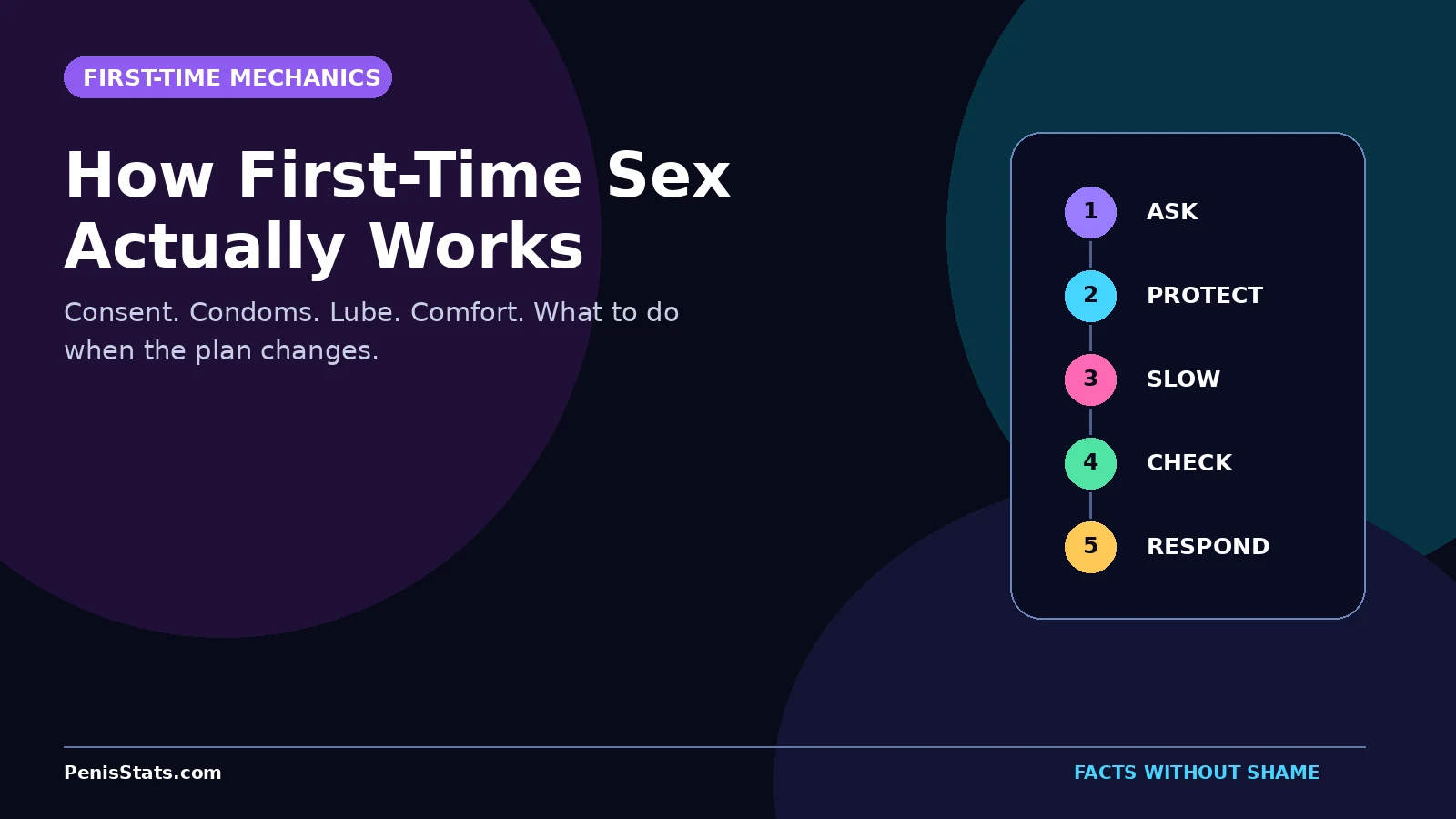
The problem with most first-time advice is that it lives at one of two useless extremes. One version says, “Just relax, it will happen naturally.” The other gives porn-style choreography as if every body has the same angles, timing, and reactions.
Neither version helps when two nervous people are actually in a room together with a condom wrapper, a bottle of lubricant, and no idea what the next thirty seconds are supposed to look like.
This guide explains the mechanics without turning sex into a performance drill. It mainly covers consensual penis-in-vagina sex because that is the situation most likely to involve pregnancy. There is also a separate section on anal sex because the mechanics and risks are different.
The three conditions that come before mechanics
Consent is not the awkward paperwork before the “real” event. It is the system that lets both people relax enough to have a good experience. A clear yes, honest check-ins, and a normal response to “stop” are practical sexual skills.
An erection, lubrication, orgasm, or any other involuntary response does not prove that someone wanted an activity. What matters is freely given, present agreement.
The anatomy map people somehow skip
The vulva is the external genital area. It includes the labia, clitoris, urethral opening, and vaginal opening. The vagina is the flexible muscular canal inside the body. The urethral opening, where urine leaves, is separate from the vaginal opening. The anus is below both.
Clitoris
The primary pleasure organ for most people with vulvas. Much of it is internal, but the visible glans sits near the top of the vulva.
Urethral opening
A small opening used for urination. It is not where a penis goes during vaginal sex.
Vaginal opening
The entrance to the vaginal canal. Its exact appearance and position vary from person to person.
Anus
A different opening with different tissue and no natural lubrication. Anal penetration needs its own plan.
The vagina is not a perfectly straight tunnel with one magic entry angle. Pelvic anatomy, position, arousal, muscle tension, and body proportions all change the alignment. That is why “aim exactly 45 degrees” is not serious universal advice. The receiving partner can usually feel the alignment better and should be encouraged to guide the pace and position.
The small preparation kit that prevents large problems
- At least two unexpired condoms, because one may be opened backward or damaged
- Water-based lubricant, or another product specifically labeled compatible with the condom material
- A private place with enough time to stop, talk, or change plans
- A towel or tissues and a trash can
- A pregnancy-prevention plan when pregnancy is possible
- Basic knowledge of where to get emergency contraception, STI care, and HIV PEP if needed
Do not hide protection because you are afraid it will “ruin the mood.” Needing a condom or lubricant is normal. The real mood killer is realizing afterward that neither person knows what happened or what to do next.
Condom mechanics, from wrapper to trash
A condom works best when it is used for the entire act of vaginal, anal, or oral sex, not placed on halfway through. Use a new condom for every act and whenever switching between partners or body openings.
- Check the package. Look at the expiration date and make sure the wrapper is intact. Condoms damaged by heat, friction, or sharp objects should be discarded.
- Open it carefully. Push the condom away from the edge and tear the wrapper with your fingers. Teeth, scissors, and sharp nails can create tiny damage.
- Confirm the direction. The rolled rim should be on the outside so it can unroll down the penis. If it touches the penis backward and will not roll, use a new one rather than flipping it over.
- Pinch the reservoir tip. Leave a small space at the end and squeeze out trapped air.
- Roll to the base. Put it on an erect penis before genital contact and unroll it fully.
- Add compatible lubricant. Put lubricant on the outside. A tiny drop inside the tip may improve sensation, but too much inside can encourage slipping.
- Check during sex. Stop if the condom rolls up, feels dry, slips, or appears damaged.
- Withdraw while still erect. Hold the condom at the base during withdrawal so it does not slip off.
- Inspect and discard. Tie or wrap it if desired and place it in the trash, not the toilet.
Two external condoms, or an external condom used together with an internal condom, create extra friction and can make failure more likely.
Lube is part of the mechanics, not an emergency repair
Lubrication reduces friction. Less friction usually means more comfort and less chance of condom damage. Natural vaginal lubrication can change with nerves, hormones, medication, hydration, stress, and arousal. A person can be very interested and still not produce much lubrication. A person can also lubricate without wanting sex.
Water-based lubricant is the simplest choice with latex condoms. Silicone-based lubricant is also compatible with many condoms and lasts longer, but check the product labels. Oils, petroleum jelly, body lotion, and many kitchen products can weaken latex.
The start-to-finish mechanics of vaginal penetration
1. Do not make penetration the starting gun
Kissing, touching, talking, and other mutually wanted activities are not a warm-up that must inevitably lead to penetration. They are sex and intimacy in their own right. They also allow arousal and comfort to build without forcing either body to perform on command.
Before penetration, ask something direct: “Do you want to try penetration?” A clear question is less awkward than guessing and much less awkward than getting it wrong.
2. Get aligned before adding pressure
Both people should be stable and comfortable. A simple face-to-face position, the receiving partner on top, or a side-by-side position can work because they allow communication and pace control. There is no universally best first-time position.
Use a hand to guide the penis only with agreement, or let the receiving partner guide it. The goal is to line the tip up with the vaginal opening, not to push around blindly. If the penis keeps meeting a thigh, labia, or pubic bone, change body position instead of adding force.
3. Start with pressure, then pause
The first movement should be slow enough that either person can stop it immediately. Gentle pressure may be enough at first. When the tip begins to enter, pause. This gives the receiving partner time to notice whether the sensation feels comfortable, too intense, or wrong.
Try a simple check-in: “Stay here, go farther, or stop?” That is more useful than repeatedly asking “Are you okay?” because it gives clear choices.
4. Let the receiving body set the first pace
Pelvic-floor muscles can tighten automatically when someone is nervous or expects pain. Force does not teach those muscles to relax. It usually teaches the body that penetration is threatening.
Go slowly, use more lubricant, change the angle, or stop. The receiving partner may prefer to control depth by moving their own hips or being on top. There is no prize for full penetration, and there is no requirement to complete it during the first attempt.
5. Movement should be adjustable, not choreographed
There is no medically correct thrust count, depth pattern, or hip circle. Start with small, slow movement and ask what feels good. Some people prefer rocking, some prefer in-and-out movement, some prefer very little penetration paired with external stimulation, and some discover that penetration is not especially pleasurable for them.
A good rhythm is simply one that both people can comfortably maintain and change. If you are working so hard that you cannot hear your partner, slow down.
6. Support your own body weight
In face-to-face positions, use knees, forearms, or hands to avoid putting all your weight on the other person. Watch wrists, shoulders, necks, and knees. A position that looks basic can still become uncomfortable quickly.
Changing position is not a failure. Say, “My arm is dying. Can we move?” Humor and honesty are better than quietly collapsing.
7. Keep checking the condom and lubrication
Friction often rises as lubricant dries. Condoms can also roll, bunch, or slip. Pause occasionally to add lubricant and feel whether the condom is still at the base. If anything seems wrong, withdraw, replace it, and restart only if both people still want to.
What to do with your hands without making assumptions
The reference article you linked gives specific suggestions such as grabbing hair, breasts, hips, or pinning hands. Those things may be welcome in some relationships, but they are not safe defaults. A first-time guide should not treat roughness or restraint as standard technique.
Safe defaults
Hold hands, touch shoulders, rest a hand on the waist, support your body, or ask where touch would feel good.
Ask first
Hair pulling, neck contact, slapping, pinning, restraints, and intense squeezing need explicit agreement, not an assumption based on porn.
“Where do you want my hands?”
“Hold my hips, but do not squeeze hard.”
Penetration is not the whole pleasure system
For many people with vulvas, clitoral stimulation is central to orgasm. Vaginal penetration may indirectly stimulate the clitoris, but penetration alone is not a guaranteed route to orgasm. That is anatomy, not a verdict on penis size or skill.
Do not turn orgasm into a deadline. Ask what kind of touch feels good. The answer may involve external touch, oral sex, a vibrator, less penetration, more time, or no orgasm at all. A good experience can include pleasure and connection without either person climaxing.
A larger penis may require more patience, shallower movement, and more position adjustment. A smaller penis may make some positions easier and others less stable. Neither body is automatically better. Mechanics are negotiated, not ranked.
If the erection disappears
An erection can fade because of nerves, a condom pause, alcohol, distraction, fatigue, pressure, or no clear reason. That does not prove erectile dysfunction, lack of attraction, or failure.
- Stop trying to force the erection back through panic.
- Say what is happening without apologizing for your existence: “I got in my head. Can we slow down?”
- Return to other mutually wanted touch or simply take a break.
- Use a new condom if the original one was removed, rolled, contaminated, or no longer fits securely.
- If erection problems keep happening across situations and are distressing, talk with a clinician.
If ejaculation happens quickly, late, or not at all
A first sexual experience can produce intense stimulation or intense anxiety. Either can change ejaculation. Finishing quickly does not predict your future sex life. Not finishing does not mean your partner is unattractive.
Do not promise a guaranteed “round two.” Refractory periods vary, and nobody owes more sexual activity. Ask what both people want next. The encounter can continue in another form, pause, or end.
Pain is information, not an initiation ritual
Mild unfamiliar pressure can happen. Sharp, burning, tearing, or escalating pain is a reason to stop. First-time vaginal sex does not need to hurt, and pain is not proof that someone was a virgin.
Pelvic-floor tightening, infections, skin conditions, insufficient lubrication, endometriosis, vulvodynia, and other health issues can make penetration painful. “Just relax” is not a diagnosis.
The bleeding myth needs to die
Some people have a small amount of spotting after first vaginal penetration. Many do not bleed at all. Hymenal tissue varies naturally and can stretch through everyday activity, tampon use, medical care, or penetration. Its appearance cannot prove whether someone has had sex.
Heavy bleeding, bleeding that continues, or bleeding combined with strong pain deserves medical attention. Nobody should try to “break” a hymen or treat blood as evidence of purity, success, or ownership.
Anal mechanics are different
Anal sex is not just vaginal technique aimed at a different opening. The anus does not produce its own lubrication, the tissue can be injured by friction, and condomless receptive anal sex carries a higher HIV-transmission risk than many other sexual activities.
- Use a condom and plenty of water-based or silicone-based lubricant
- Start slower than you think and let the receiving partner control pace
- Stop for sharp pain, tearing, or significant bleeding
- Use a new condom before moving from the anus to the vagina
- Wash hands and toys before changing body openings
- Remember that anal sex does not directly cause pregnancy, but semen near the vulva can still create pregnancy risk
Some people enjoy anal sex and some never do. Correct technique does not create an obligation to like it.
The final mechanics: ejaculation, withdrawal, and cleanup
If using an external condom, ejaculation can happen inside the condom. Afterward, hold the condom at the base and withdraw while the penis is still firm. Move away from the partner’s genitals before removing it so semen does not spill onto the vulva or vaginal opening.
Check whether the condom appears intact. Wrap it and place it in the trash. Gently wash external genitals with water and mild, unscented soap if desired. Do not douche. Douching does not prevent pregnancy or STIs and can irritate the vagina.
Urinating after sex may feel comfortable and is commonly suggested for people prone to urinary infections, but it does not prevent pregnancy or remove an STI. It is not a substitute for protection or testing.
If the condom breaks, slips, or was never used
Time-sensitive options work based on hours and days, not whether the sex was your first time.
- Pregnancy possibility: Emergency-contraception pills should be taken as soon as possible within five days. Some options work better than others later in that window, and an IUD can also be used as emergency contraception.
- Possible HIV exposure: HIV PEP must be started within 72 hours, and sooner is better. Seek urgent medical evaluation rather than waiting for symptoms.
- STI concerns: Testing immediately may be too early for some infections. A clinician can recommend the right tests and timing.
- Assault or condom removal without agreement: Medical care can address injuries, emergency contraception, PEP, testing, and evidence options. You do not have to decide immediately whether to report.
The emotional mechanics afterward
Aftercare is not reserved for intense sex. First-time sex can leave people feeling close, relieved, shaky, proud, uncertain, disappointed, happy, or several of those at once.
Ask simple questions:
“How are you feeling? Do you want water, space, a bathroom, or to stay close?”
“I wanted to check in. Is there anything you liked, did not like, or want us to handle differently?”
Do not turn private details into group-chat entertainment. Do not share photographs, body descriptions, bleeding, performance, or someone’s sexual history as proof that the experience happened.
Myths that create bad mechanics
The five sentences that solve most first-time problems
- “Do you want to keep going?”
- “Slower, faster, stay there, or stop?”
- “Where do you want my hands?”
- “I need a pause. Nothing is wrong.”
- “The condom may have failed. Let’s check the time and handle it together.”
The bottom line
First-time sex is not a sequence you complete correctly. It is a conversation carried out with bodies. The mechanics that matter are simple: get clear agreement, use protection, understand the anatomy, add lubricant before friction becomes pain, begin slowly, let feedback control the pace, and stop without drama when either person wants to stop.
The goal is not to look experienced. The goal is for both people to feel safe enough to be honest.
You may not complete penetration. One person may not orgasm. An erection may disappear. The condom may take three attempts. None of that makes the experience a failure. Ignoring pain, pressure, a boundary, or a protection problem is what turns ordinary awkwardness into harm.
Sources and verification notes
This article avoids unsourced first-time percentages, universal position angles, and invented timing rules. Medical and safety claims were checked against the following sources on July 20, 2026.
- CDC: Condom Use Overview
- RAINN: Consent 101
- Cleveland Clinic: Vagina Anatomy
- Cleveland Clinic: Vulva Anatomy
- Cleveland Clinic: Clitoris Anatomy and Function
- ACOG: When Sex Is Painful
- WHO: Eliminating Virginity Testing
- Planned Parenthood: What Happens the First Time You Have Sex?
- Planned Parenthood: How Do I Make Sex Safer?
- CDC: Emergency Contraception
- CDC: Preventing HIV With PEP
- CDC: Getting Tested for STIs
Your measurement is not your mechanics
Size can change which adjustments feel comfortable, but it cannot measure patience, communication, consent, or whether someone feels safe with you.
Open the Penis Size Calculator