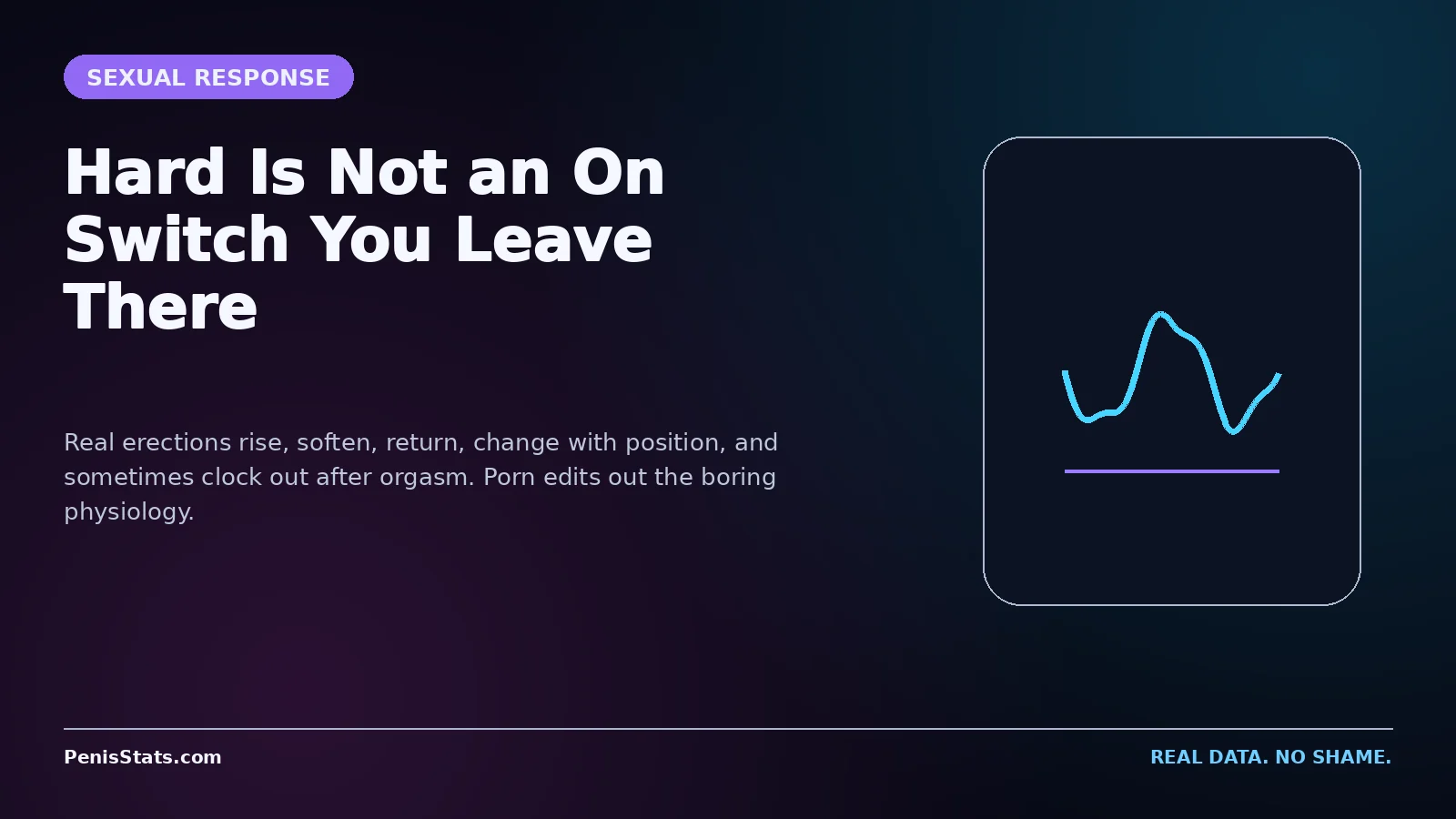
Popular sex stories have two settings: completely soft before sex and perfectly hard until the exact second the scene ends. Real bodies are less cinematic.
An erection is an active physiological state. Blood flow, smooth muscle, nerves, attention, sensory input, stress, and context keep changing. A penis can become firmer, soften, return, or need different stimulation while the person remains interested and the experience remains good.
Sexual response is not a straight line
The classic excitement-plateau-orgasm-resolution diagram is useful, but research finds more variable male response patterns. Some men fluctuate. Some reach high arousal quickly. Some take longer. Some do not orgasm. Some enjoy the experience without maintaining one level of erection throughout.
Firmness is a body state, not a live rating of your partner. A change can mean “the stimulation changed,” “my attention moved,” “I need a pause,” or nothing important.
Ordinary reasons firmness changes
- A pause to put on a condom or change position.
- Less direct or different stimulation.
- Cold, discomfort, pain, or needing to urinate.
- Thinking about pregnancy, privacy, performance, or being interrupted.
- Alcohol, fatigue, medication, stress, or illness.
- Feeling rushed, watched, unsafe, or emotionally disconnected.
- Orgasm and the resolution phase.
The refractory period is not rejection
After orgasm and ejaculation, many men enter a refractory period during which another erection or orgasm is difficult or temporarily impossible. Its length varies between people and across age, health, context, and occasions. The science is still more complicated than one hormone or one stopwatch.
A person may want affection, closeness, or more sexual contact while his penis is in recovery. Another person may want space or sleep. Ask instead of interpreting.
What helps in the moment
- Stop grading. Constantly checking firmness pulls attention away from sensation.
- Say what is happening without apologizing for existing: “I softened a bit. Let’s slow down.”
- Return to touch or activities that feel good without making penetration the deadline.
- Fix practical issues such as condom fit, lubricant, cold, pain, or an awkward position.
- Take stopping seriously. Nobody owes continuation while waiting for a body response.
Partners can make this easier or much worse
Helpful responses include warmth, patience, humor, and no personal accusations. Unhelpful responses include “You do not find me attractive,” mocking, demanding penetration, or treating an erection as proof of masculinity.
“No pressure. Do you want to keep touching, switch things up, take a break, or stop?”
“I am enjoying this. My body is changing gears, not issuing a review.”
When normal variation becomes a health concern
Get medical advice when difficulty getting or keeping an erection is persistent, recurring, distressing, or a major change. Also seek care for pain, injury, new curvature, reduced sensation, medication effects, cardiovascular risk, diabetes symptoms, or hormonal concerns.
Do not use morning erections as a perfect home diagnostic test. Do not use one successful masturbation session to prove everything is “in your head.” Physical and psychological factors can overlap.
Sex can still be successful without a perfect erection
That sentence sounds obvious until a person has been taught that sex equals penetration and penetration equals a continuously hard penis. Sexual pleasure can involve touch, oral sex, toys, hands, fantasy, conversation, closeness, or stopping happily. What counts should be decided by the people involved.
This is not consolation sex. It is recognizing that a whole encounter does not have to orbit one organ's current hydraulic status.
Erection and orgasm are related, not identical
A person can sometimes orgasm with an erection that is not at maximum firmness, and an erection can occur without orgasm. Ejaculation, orgasm, desire, and erection are coordinated but distinct processes. Medication, surgery, injury, anxiety, and individual variation can separate them further.
This is another reason a single hardness scale cannot summarize the encounter. Someone can be enjoying intense sensation without looking like a performer in a paused video frame.
The “spectator” problem
Sex therapists sometimes describe people becoming spectators to their own performance. Instead of feeling touch, they watch themselves from an imaginary camera: Am I hard enough? Do I look experienced? Is my partner disappointed? That monitoring steals attention from the very signals that support arousal.
Return to concrete sensation, breathing, communication, and what feels wanted. The point is not to force an erection through mindfulness. It is to stop adding an unnecessary audience.
The bottom line
Erections are dynamic. Sexual response is variable. The body can change without attraction disappearing, consent changing, or the encounter failing.
Hardness is useful information. It is not the scoreboard.
Research notes and sources
Medical guidance changes, especially for testing, vaccines, contraception, and emergency care. These sources were checked for this article; local clinicians and product instructions should guide personal decisions.
- Challenging the standard model of male sexual response — Evidence for multiple and fluctuating male sexual-response patterns.
- Cleveland Clinic: Sexual response cycle — Medically reviewed overview of response phases and refractory period.
- Evolving ideas about the male refractory period — Review of uncertainty and physiology around the refractory period.
- Physiology, Erection — Current overview of erection and detumescence physiology.
- NHS Sex Therapy London: erection difficulties — Practical guidance on common erection variability and when to seek assessment.
Your number is context, not destiny
The calculator can place a measurement in a clinical distribution. The Field Guide handles the parts a percentile cannot answer.
Open the Penis Calculator